USGS - science for a changing world

Amphibian Research and Monitoring Initiative

ARMI » Topics » Disease

Disease


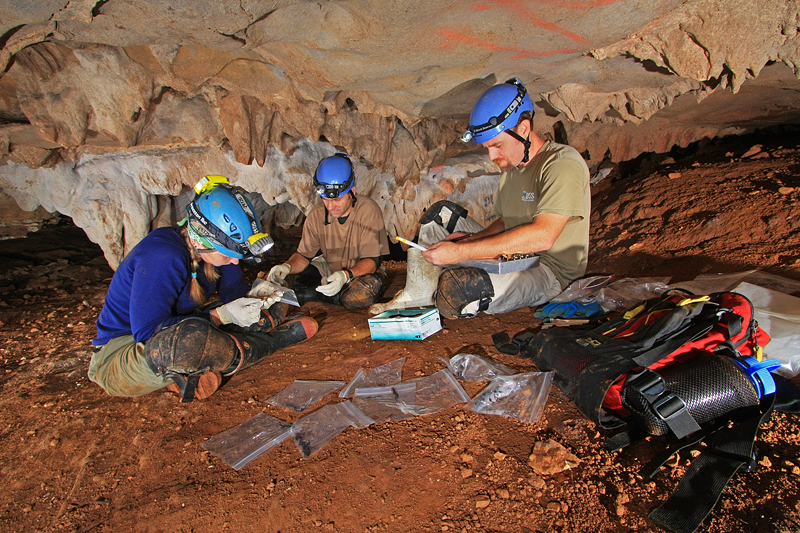
Cave Bd sampling
Left to Right: Tabby Cavendish (Great Smoky Mountains NP), Brian Gregory (USGS), and Jamie Barichivich (ARMI) swabbing salamanders for Batrachochytrium dendrobatidis (Bd) in Rockhouse Cave, Wheeler NWR, Alabama. Photo by: Alan Cressler.

ARMI conducts original research on various amphibian diseases in the lab and field. Our research has included estimating the impacts of diseases on the growth of populations, developing and testing potential treatments, affects of stressors on susceptibility to disease, how diseases are transmitted in the wild, and how to model disease distributions and spread.

ARMI disease research is conducted throughout the country, but ARMI pathologist Dr. David Green is based at the National Wildlife Health Center in Madison, Wisconsin, and coordinates the health screenings and investigations of amphibian mortalities (e.g., identification, pathology) in addition to collaborating on many disease research projects.

Amphibians at our long-term monitoring sites are periodically screened for diseases and we investigate mass mortality events.

Resources
National Wildlife Health Center - ARMI

ARMI Products on Disease

* USGS neither sponsors nor endorses non-USGS web sites; per requirement "3.4.1 Prohibition of Commercial Endorsement."

This is an ARMI Product. Experimental evidence for American bullfrog (Lithobates catesbeianus) susceptibility to chytrid fungus (Batrachochytrium dendrobatidis)
Authors: Gervasi SS, Urbina J, Hua J, Chestnut T, Relyea RA, Blaustein AR | Date: 2013-03-29 | Outlet: EcoHealth DOI: 10.1007/s10393-013-0832-8 | Format: URL
The emerging fungal pathogen, Batrachochytrium dendrobatidis (Bd), has been associated with global amphibian population declines and extinctions. American bullfrogs (Lithobates catesbeianus) are widely reported to be a tolerant host and a carrier of Bd that spreads the pathogen to less tolerant hosts. Here, we examined whether bullfrogs raised from eggs to metamorphosis in outdoor mesocosms were susceptible to Bd. We experimentally exposed metamorphic juveniles to Bd in the laboratory and compared mortality rates of pathogen-exposed animals to controls (non-exposed) in two separate experiments; one using a Bd strain isolated from a Western toad and another using a strain isolated from an American bullfrog. We wanted to examine whether metamorphic bullfrogs were susceptible to either of these strains. We show that bullfrogs were susceptible to one strain of Bd and not the other. In both experiments, infection load detected in the skin decreased over time, suggesting that metamorphic bullfrogs from some populations may be inefficient long- term carriers of Bd.

Site in Colorado
Battaglin WA  
This is an ARMI Product. Occurrence of Pesticides in Water and Sediment Collected from Amphibian Habitats Located Throughout the United States, 2009-2010
Authors: Smalling KL, Orlando JL, Calhoun D, Battaglin WA, Kuivila KM | Date: 2012-08-22 | Outlet: U.S. Geological Survey Data Series 707 | Format: URL
Water and bed-sediment samples were collected by the U.S. Geological Survey (USGS) in 2009 and 2010 from 11 sites within California and 18 sites total in Colorado, Georgia, Idaho, Louisiana, Maine, and Oregon, and were analyzed for a suite of pesticides by the USGS. Water samples and bed-sediment samples were collected from perennial or seasonal ponds located in amphibian habitats in conjunction with research conducted by the USGS Amphibian Research and Monitoring Initiative and the USGS Toxic Substances Hydrology Program. Sites selected for this study in three of the states (California, Colorado, and Orgeon) have no direct pesticide application and are considered undeveloped and remote. Sites selected in Georgia, Idaho, Louisiana, and Maine were in close proximity to either agricultural or suburban areas. Water and sediment samples were collected once in 2009 during amphibian breeding seasons. In 2010, water samples were collected twice. The first sampling event coincided with the beginning of the frog breeding season for the species of interest, and the second event occurred 10–12 weeks later when pesticides were being applied to the surrounding areas. Additionally, water was collected during each sampling event to measure dissolved organic carbon, nutrients, and the fungus, Batrachochytrium dendrobatidis, which has been linked to amphibian declines worldwide. Bed-sediment samples were collected once during the beginning of the frog breeding season, when the amphibians are thought to be most at risk to pesticides. Results of this study are reported for the following two geographic scales: (1) for a national scale, by using data from the 29 sites that were sampled from seven states, and (2) for California, by using data from the 11 sampled sites in that state.<br />
<br />
Water samples were analyzed for 96 pesticides by using gas chromatography/mass spectrometry. A total of 24 pesticides were detected in one or more of the 54 water samples, including 7 fungicides, 10 herbicides, 4 insecticides, 1 synergist, and 2 pesticide degradates. On a national scale, aminomethylphosphonic acid (AMPA), the primary degradate of the herbicide glyphosate, which is the active ingredient in Roundup®, was the most frequently detected pesticide in water (16 of 54 samples) followed by glyphosate (8 of 54 samples). The maximum number of pesticides observed at a single site was nine compounds in a water sample from a site in Louisiana. The maximum concentration of a pesticide or degradate observed in water was 2,880 nanograms per liter of clomazone (a herbicide) at a site in Louisiana. In California, a total of eight pesticides were detected among all of the low and high elevation sites; AMPA was the most frequently detected pesticide, but glyphosate was detected at the highest concentrations (1.1 micrograms per liter).<br />
<br />
Bed-sediment samples were analyzed for 94 pesticides by using accelerated solvent extraction, gel permeation chromatography for sulfur removal, and carbon/alumina stacked solid-phase extraction cartridges to remove interfering sediment matrices. In bed sediment, 22 pesticides were detected in one or more of the samples, including 9 fungicides, 3 pyrethroid insecticides, p,p’-dichlorodiphenyltrichloroethane (p,p’-DDT) and its major degradates, as well as several herbicides. Pyraclostrobin, a strobilurin fungicide, and bifenthrin, a pyrethroid insecticide, were detected most frequently. Maximum pesticide concentrations ranged from less than their respective method detection limits to 1,380 micrograms per kilogram (tebuconazole in California). The number of pesticides detected in samples from each site ranged from zero to six compounds. The sites with the greatest number of pesticides were in Maine and Oregon with six pesticides detected in one sample from each state, followed by Georgia with four pesticides in one sample. For California, a total of 10 pesticides were detected among all sites, and 4 pesticides were detected at both low and high elevation sites; tebuconazole and pyraclostrobin were the two most frequently detected pesticides in California. For the other six selected states, the most frequently detected pesticides in bed sediment were pyraclostrobin (detected in 17 of 42 samples), bifenthrin (detected in 14 of 42 samples), and tebuconazole (detected in 10 of 42 samples).<br />
<br />
The fungus, Batrachochytrium dendrobatidis (Bd), was detected in water samples in sites from four of the seven states during 2009 and 2010, and the number of zoospore equivalents per liter of water in samples where Bd was detected ranged from 1.6 to 343. Bd was not detected in water samples from sites in Georgia, Louisiana, and Oregon.

This is an ARMI Product. Disease in a dynamic landscape: Host behavior and wildfire reduce amphibian chytrid infection
Authors: Hossack BR, Lowe WH, Ware JL, Corn PS | Date: 2013 | Outlet: Biological Conservation 157: 293-299 | Format: .PDF
Disturbances are often expected to magnify effects of disease, but these effects may depend on the ecology, behavior, and life history of both hosts and pathogens. In many ecosystems, wildfire is the dominant natural disturbance and thus could directly or indirectly affect dynamics of many diseases. To determine how probability of infection by the aquatic fungus Batrachochytrium dendrobatidis (Bd) varies relative to habitat use by individuals, wildfire, and host characteristics, we sampled 404 boreal toads (Anaxyrus boreas boreas) across Glacier National Park, Montana (USA). Bd causes chytridiomycosis, an emerging infectious disease linked with widespread amphibian declines, including the boreal toad. Probability of infection was similar for females and the combined group of males and juveniles. However, only 9% of terrestrial toads were infected compared to >30% of aquatic toads, and toads captured in recently burned areas were half as likely to be infected as toads in unburned areas. We suspect these large differences in infection reflect habitat choices by individuals that affect pathogen exposure and persistence, especially in burned forests where warm, arid conditions could limit Bd growth. Our results show that natural disturbances such as wildfire and the resulting diverse habitats can influence infection across large landscapes, potentially maintaining local refuges and host behaviors that facilitate evolution of disease resistance.

Accessibility FOIA Privacy Policies and Notices

Take Pride in America logo USA.gov logo U.S. Department of the Interior | U.S. Geological Survey
URL: http://armi.usgs.gov/topic.php?topic=Disease
Page Contact Information: ARMI Webmaster
Page Last Modified: Thursday, May 23, 2013